
Fosco and Oz had a (very small-scale) eighteen-month anniversary celebration in SoMa last Friday night. They had dinner at Northern California's fanciest food court at the Westfield San Francisco Centre. You can tell it's a fancy food court because they have real silverware. They also have an outpost of Beard Papa!
Oz was in the mood for spicy tuna, so he opted for a spicy tuna bowl:
Fosco was in the mood for the deliciousness of the Slanted Door's takeout version, Out the Door. Out the Door serves Fosco's favorite green papaya salad: Fosco is not normally agog over green things, but this salad is exquisite. It's fresh and clean and complex and totally rejuvenating (the french-fried onions really rock it). Sadly, Fosco cannot recommend the Egg Noodles with Shrimp Stir-Fry--an unfortunate failure for such a consistently good place to eat.
After dinner, Fosco and Oz headed down the street for an after-hours corporate reception at the SFMOMA (thanks to Oz's employer, which may or may not be Mmm Carpets). It was a surprisingly hip event. The SFMOMA's atrium was almost clubby, with a DJ and everything. 
The best part, of course, is that all of the galleries were open. Fosco and Oz had been to the museum recently, so there wasn't much new. However, they got a nice second look at the Martin Puryear show. Most of Puryear's work is on some borderline between wood crafts and art, usually on a (very) large scale. A surprising amount of the Puryear exhibit leaves Fosco cold, but he does really appreciate this work, entitled "Brunhilde":
The longer you walk around this piece, the more interesting it becomes. Fosco also enjoys Puryear's little tiny ladder on display in the SFMOMA's atrium:
There is a nice (short) piece on Puryear's art here that I think is helpful.
We had also seen the exhibit called "Art of Participation" before, but we walked through it again. One of the best pieces is by Fosco's adored Félix González-Torres. This is Untitled (1992-93):
The work is essentially a big stack of prints on large sheets of paper (like 2.5 X 3.5 ft). The prints are all the same. Viewers are encouraged to take one of the prints home with them. The stack is replenished forever. Isn't that cool? Right now, Fosco has one on the wall near his desk (don't worry--Oz and I have another one to frame someday):
The last time Fosco was at this exhibit, the ANT FARM Media Van wasn't working correctly. Luckily, it was running smoothly on Friday night. The Media Van is a gutted van that is the repository for a digital time capsule (which will be opened in the year 2030, assuming humans still exist then). Inside the van, there are hookups for iPods, cell phones, cameras, etc. Visitors are encouraged to hook up an electronic device to the van; the van then randomly downloads a file from that device for inclusion in the digital time capsule. Once you the van copies your file, it spits out a receipt for you (which is good for 10% off in the SFMOMA store!). Here is Fosco's receipt:
As you can see, the van randomly selected a Bloc Party song from Fosco's iPod. Fosco realized afterward that this could have been a very embarrassing situation: can you imagine putting some horrible song into a time capsule to be played in 2030? Now Fosco doesn't have a ton of bad music on his iPod, but there are still some things he wouldn't be thrilled about (Bon Jovi, Aly and AJ, Roxette...) Luckily, Bloc Party is acceptable in terms of street cred (and "Sunday" is a particularly good song with a particularly good chorus for an anniversary: "I love you in the morning / When you're still hung over.") And who knows? Maybe in 2030, that song will still sound totally rad.
Come to think of it, Fosco and Oz will celebrate their twenty-three year anniversary in 2030.
Tuesday, January 27, 2009
SFMOMA by night


Friday, December 22, 2006
SFMOMA Roundup: "There is a light that never goes out."
Last Friday, Fosco and his sister Maggie Tulliver spent an afternoon in San Francisco. Of course, there was a visit to Beard Papa for creampuffs (try the milktea flavor--it's splendid!) and to the Pirate Store (where much money was spent and where sister Maggie got mopped). But the highlight of the trip was the visit to the SFMOMA to see two exhibits.
The first exhibit we saw was the retrospective of recent work by German artist Anselm Kiefer, entitled Anselm Kiefer: Heaven and Earth. The organizing principle of the show is Kiefer's concerns with heaven, responsibility, and the afterlife. And, of course, because this is Kiefer, you can bet that there is collective German guilt in there as well.
I've always been a bit suspicious of Kiefer for several reasons. First, looking at his paintings always makes me wonder what kind of nightmare it is to curate his work. The paintings are so huge and so clumpy: how do you move them? Does stuff fall off? And what about all that lead? Does the curatorial staff have to wear hazmat suits? And isn't it all so heavy? And what to make of all the non-traditional materials in the paintings (e.g., straw, sunflower seeds, sticks)--aren't those things going to start to rot at some point?
The second reason that I can't quite catch Kiefer-fever is the overwhelming seriousness of his paintings. They are entirely irony-proof. I mean, how do you laugh at works that are so dark and that almost always make explicit reference to the Holocaust? All that German guilt is a big downer (and a bit heavy-handed).
That being said, I was surprised, however, at how powerful some of the work in this show was. There were actually several pieces that were absolutely ravishing, including Sternenfall (1995) (seen below): There was also the amazing piece below, which is about six feet tall. Each page is coated with lead and depicts a different star field map. (Of course, there are conservation issues here too--there was a grey lead sheen all over the floor under this one).

The problem with these pictures is that they don't capture how gigantic these works are. Kiefer's paintings dwarf you--and that's often part of their power. There was a third work that was just gorgeous, but that I am only finding in a very low-quality image file online. It's called "The Sixth Trumpet" (1996) and you can see it below. 
I'm afraid it doesn't look like much here, but imagine it in its true dimensions: 16 x 18 feet. At that size, the cloud of black dots look both beautiful and menacing. From a distance, you wonder what that cloud is: locusts? black rain? However, when you approach the canvas, you realize that the dots are black sunflower seeds--one of the more remarkable touches in Kiefer's work in this show.
Of course, there are still a few clunkers here. My least favorite was the painting you see below, entitled "Quaternity" (1973). You can see the traditional rustic cabin interior of Kiefer's early work, plus three flames and one serpent. Each of the flames is labeled with the name (in German) of one of the members of the Holy Trinity; the serpent is labeled as Satan, making the Trinity a Quaternity. Get it? Yeah, you and anyone with an IQ above a precocious ten-year-old. This painting isn't quite what I expect art to do for me... 
However, it would be churlish to dwell too long on the shortcomings of this painting (and a few of its ilk) when much of Kiefer's recent work is much better. I may not have become a complete convert to Kiefer after this exhibit, but I did find several works of his that I love.
Luckily, the perfect anecdote to Kiefer's Teutonic Gloominess was taking place just one floor above, with an exhibit of new work by Phil Collins. Oops, I meant this Phil Collins. Collins's video installation, entitled dünya dinlemiyor (2005), is hilarious, sweet, and completely compelling. Basically, Collins has filmed young Turkish people in Istanbul doing karaoke to songs by The Smiths. They sing in English against generic backgrounds of "pretty scenery" (e.g., mountains, beaches, forests). Some are pretty good and some are pretty horrible. All of them are absolutely fascinating. I had intended only to watch one of the performances (because I hate karaoke), just to get the idea, but I ended up watching the entire hour. Sure, the performances raise questions of imperialism, consumerism, and globalization (how do these Turks know The Smiths? Why do they all seem to want to be rock stars?); however, this is the least interesting aspect of the work. Rather, it is extraordinarily thrilling to watch the self-presentations of these (mostly) youths--their joy and confidence are infectious, their vulnerability is heartbreaking. I feel that I know these people quite intimately (and yet, I know nothing about them).
Some of the highlights, include the tightly-focused young man (below) singing the gorgeous ballad "Asleep." His sensitivity and introspection were powerful. 
I loved the two girls below, who sang "There Is a Light That Never Goes Out." The verses were performed competently, but it was the rush of enthusiasm that overtook them at the chorus that was priceless. Watching them sing "If a double-decker bus crashes into us..." was funny and charming.
There were two other performances not to be missed (but for which I cannot find pictures):

- the incredibly sexy young man who performs "Ask" with his shirt entirely open (and who has beautifully hairy chest)--woof! Gaydar doesn't always work cross-culturally, but I have my eye on him...
- the delightful indie chick who performs "Half A Person" with a completely startling voice (reminiscent of Edie Brickell) and a killer smile. If there is such a thing as "Turkish Idol," I think she could win it. [N.B., apparently the Turkish version is called "Popstar." Why does this not surprise me?]
If you want to get a better sense of what all this was like, I would hesitantly point you in the direction of this clip on YouTube. Unfortunately, it isn't the best performance from the installation, but it might give you an idea.
All I know is that, the whole way home, I sang along to Smiths songs. Apparently, that's all we need to bring the world together.
Saturday, September 16, 2006
If you see one Matthew Barney film this year...
[Finally, after a week and multiple promises, Fosco delivers his review of Matthew Barney's Drawing Restraint at the SFMOMA.] I've seen more Matthew Barney than most people. We go back a long way. I saw the original exhibit of Cremaster 2 at the SFMOMA in 2000. I spent an entire afternoon at the Guggenheim New York in 2003 to see the Cremaster Cycle exhibit. That fall, I spent over seven hours in a theater (in Grand Rapids, MI), watching the complete Cremaster Cycle. I hope this solidly establishes my Matthew Barney credentials...
In all of my Matthew Barney contemplation, I have reached several conclusions:
- Only his films themselves are worthy of appreciation as art. Each film is generally accompanied by a physical exhibitions of sculpture, drawings, photographs and artifacts that relate to the film. This exhibition is never worthy of the film itself. Without the film, the sculptures are almost completely unevocative. His drawings tend to be either banal or incomprehensible. Sometimes the vitrines he designs for the display of drawings are pretty nifty, but come on--he just shouldn't be allowed to work in any medium besides film.
- Never has a Matthew Barney interview increased my understanding or enjoyment of one of his films. He is not to be listened to. Let the films speak for themselves.
- He needs an editor. Isn't it interesting how great writers are often improved by good editing? Do you ever read recent novels by famous writers and bemoan the fact that they are now too famous to admit editing? Art doesn't always spring forth from the mind of the artist in its most powerful form--sometimes the editor is necessary. Consequently, there are a few hours of Barney's Cremaster series that could be excised with no consequent diminishment of artistic merit.
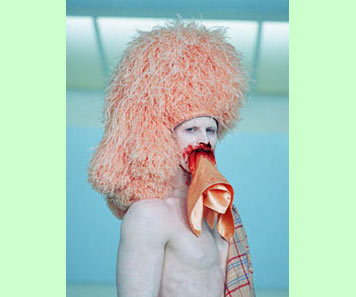 That being said, I need also to note one more thing: despite all of his faults, I love him. The Cremaster Cycle was one of the most transcendent art experiences of my life and I will continue to contemplate it for decades. Some future Halloween, I even plan to attend a costume party dressed as the "Entered Apprentice" from Cremaster 3 (picture at left). So, consequently, I approached the Drawing Restraint exhibit at SFMOMA with a great deal of anticipation.
The physical exhibit itself can be dispensed with by repeating one of my conclusions from above: "only the films themselves are worthy of appreciation as art." Now let's talk about the film.
 The most interesting new element in Matthew Barney's recent artistic milieu is the presence of his ladyfriend Bjork. As much as I hate to disagree with the dreamy Alex Ross (aka, Mr. "I'm hanging out at Carnaval in Brazil with Bjork and Matthew Barney, so SUCK IT, Anthony Tommasini!"), I'm not really a big fan of Bjork's music. In fact, apart from a song here or there (like "Bachelorette," which is an exceptional song), I think her best work was on Selmasongs, the soundtrack to Dancer in the Dark. In fact, as much as I love her whole "adorable Icelandic pixie" thing, I was beginning to think her a bit overrated. Her presence in the movie, therefore, worried me a bit.
I should not have feared. The film was phenomenal. Somehow, working together has allowed Barney and Bjork to do the best work of their careers. I've now seen it three times. Before we go further, go watch the trailer again.
Before we go too much further, it's time for a plot summary (such as it is...):
- the film opens with an exquisitely beautiful scene of a Japanese woman wrapping two halves of a krill fossil as gifts.
- we see sweeping helicopter shots of a Japanese port city and watch a crew of jumpsuited workers build a gleaming white dock on the water.
- a decorated tanker truck is pulled through a refinery, preceded by a parade of dancing Japanese dancers and children.
- the camera descends one of the smokestacks at the refinery, looking upward; we splash into a bath of golden petroleum and watch strands of bubbles flow toward the surface; a dark, whale-like shape passes over us and the titles, in bronze flensing-knife font, spread across the screen. This is probably the most beautiful shot in the film and it left me completely breathless. You can get a sense of it from the trailer.
- the tanker arrives at the whaling ship, the Nisshin Maru, on whose deck a large steel cast of Barney's "field symbol" (it's that lozenge-with-a-bar-through-it that you see all over his work) has been created. The field symbol is filled with liquid petroleum jelly. This is the third shot in the trailer.
- pearl divers put on makeup, prepare their equipment, and go diving. They come across a large floating chunk of ambergris.
- strung with colored paper, the Nisshin Maru pulls away from the dock and heads out to sea.
- the chef of the Nisshin Maru (in a very witty scene), cooks dinners of whale blubber (shaped like the "field symbol") with pomegranite seeds and prawns.
- Bjork, cute as a button in a red winter wrap and hiking boots, waits on the shore for a boat to pick her up. One does.

- Matthew Barney (as the other "Occidental Guest") waits on a pier for his motorboat, which arrives.
- Bjork arrives at the Nisshin Maru and is lifted on board in a basket; she is undressed and takes a bath. You see her naked from behind through a scrim--you just get a hint of public hair. Also, you see her remarkably pointy breasts underwater.
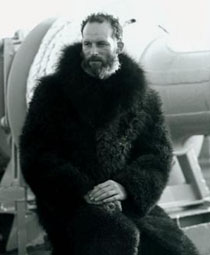
- MB arrives on board the boat, removes his furry, furry overcoat and has his beard shaved off.
- MB lays down to sleep on a tatami mat.
- during the night, the crew plays a mock game of whale-harpooning on the deck.
- as MB sleeps, a drunk crew-member slips into his quarters and shaves off MB's eyebrows and shaves a large bald swath on the top of his head from his forehead to his crown.
- the next morning, there is much unsuccessful whale hunting, but the ship does find and take onboard the large floating chunk of ambergris.
- Bjork has her hair done (with many sea anemones!) and is dressed in animal skins; MB awakes and is also dressed in strange clothing. MB does full frontal nudity in this scene (uncircumcised, it appears), but Bjork does not.

- Once they have been attired, they (eventually) enter the tea ceremony room. The tea master appears and MB speaks the first spoken line in the film (over an hour in at this point): "Please come in." A long ritualized tea ceremony follows, in which Bjork says her one line (in Icelandic): "Thank you for inviting me." After the tea, MB asks the tea master (in an extremely stilted manner): "Can you tell us something about the vessel?" This leads to a long monologue by the tea master about the history of the Nisshin Maru, about the special effects of the ambergris onboard, and about the psychological scars left by the Nisshin Maru's collision with a Greenpeace boat near Antarctica. Once this monologue is over, there are no remaining spoken words in the film (at least another hour at this point).
- as the tea ceremony goes on, the workers on the deck above have stowed the ambergris log in the hull and have cut the bar from the middle of the now-solid petroleum jelly field symbol. The bar is hoisted to a different part of the deck and is cut into blocks using flensing knives. The blocks of jelly are fed into the ships boiler and are melted.
- Night falls. Bjork and MB remain in the tea room alone. They begin to make out, animalistically. There is licking of faces and noses. It's hot. MB gets one of the anemone spines from her hair stuck into his forehead. She pulls it out. It's very hot. A storm blows up. The ship is now strangely deserted (except for the couple). The boiler begins to overflow with petroleum jelly and the jelly slowly begins to fill the tea room.
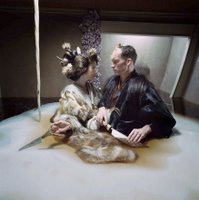
- This is where things get a little weird. A flensing knife floats into the room and MB picks it up and begins to cut Bjork's legs with it. Bjork picks up her dagger and cuts his legs in return. There is some blood, but not as much as there should be. The couple continues their cutting as the petroleum level rises. Eventually, they manage to cut off each other's feet. Then they keep cutting. They break for a moment to feed each other a delectable morsel from their own thighs--sashimi-style. "Mmmm... Delicious Bjork." This is upsetting, but their faces remain placid as they float in a "cloud" of hardening petroleum jelly. Eventually, they slice each other's legs off entirely. Somehow, their lower torsos transform into whale-like tails and blowholes appear in the backs of their necks. They dive into the oil.
- While MB and Bjork complete their transformation, the workers on the deck remove the sides of the field symbol mold and the unstable petroleum jelly begins to collapse on the deck.
- The Nisshin Maru is now surrounded by icebergs. We see two whales surface near the ship, blow, and dive again heading away from the ship. Is this MB and Bjork? Your guess is as good as mine.
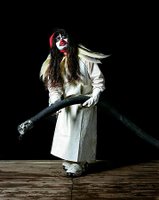
- The "petrolatum" spirit, hiding belowdecks, begins to refill a mold with petroleum jelly.
- A pearl diver surfaces and spews pearls from her mouth. The pearls sink to the ocean floor and form two interlocking circles.
- A small concrete deck is pulled from the sea by a chain onto the dock next to the gleaming white one built early in the film. The concrete dock collapses under the weight of the model.
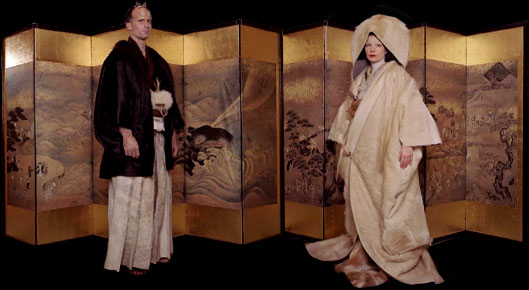
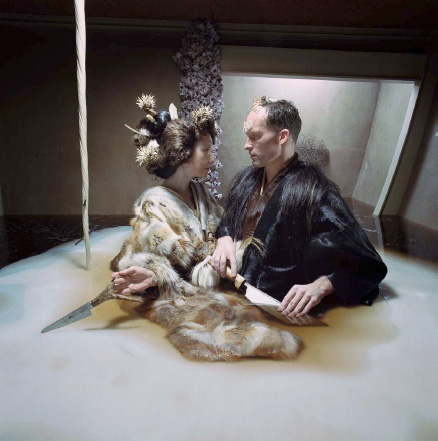
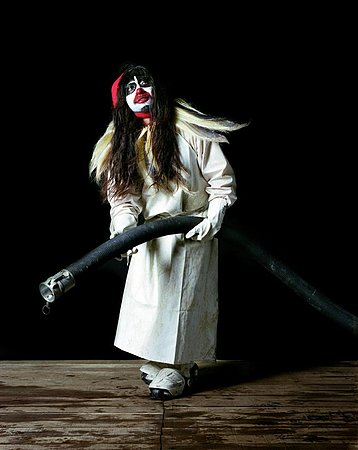
What could all this mean?
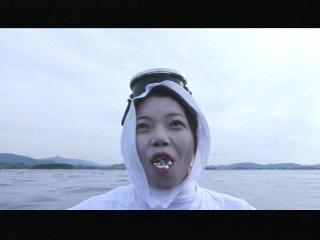 Well, as you can tell, Barney's work is really more interesting for its images than for its stories. And you can tell which images made a serious impression on me. You can get a sense of many of these images from the trailer, luckily. As for the narrative, well, I wouldn't worry too much about it. Just consider it an opportunity to think for a while about ritual, social constraint, oil, and biological plasticity.
Why is this film so good (apart from the fact that it is so absolutely gorgeous)?
- Matthew Barney, finally, has learned to edit--at least to some extent. Granted, 145 minutes is not svelte, but five years ago this film would have been six hours long. In almost no scene does Barney let the action occur in real time. This is a significant improvement over several of the Cremaster films (especially 1, 4, and 5).
- Bjork's music is wonderful. She singlehandedly moves several slower scenes along with her music. Although Jonathan Bepler's music for several of the Cremaster films was interesting, it was never meant to be an equal partner to the visual images. I'm beginning to think that Bjork does her best work when she is contrained by having to write music for a film.
- It is such a thick text. You can spin so many interpretive webs from these dark materials. It's so allusive that many areas of knowledge are in play: Japanese culture, physics and chemistry, marine biology, whaling history and practice, and, of course, Barney's previous artistic work in both the Cremaster and Drawing Restraint series.
- It's totally sexy (and discomfiting at the same time). As Fosco has said recently: "I like things that make me horny and uncomfortable at the same time."
Friday, September 15, 2006
SFMOMA, Part 2: "Hey, there's art in here!"
Now that we've tasted the crust of the pie that is the SFMOMA (in Part 1), we can fork the creamy, creamy filling inside.  Fosco loves contemporary art--loves it! So naturally, he enjoys lurking (with notebook) in the galleries at the SFMOMA, winking at sexy strangers, and hastening together to the bathroom for a quickie... Oh wait, or maybe that was an episode of Queer As Folk. But, anyway, Fosco still loves the art. Here are the highlights from several of the exhibits that he saw during his three(!) recent trips to the SFMOMA.
The exhibition "Between Art and Life" is designed to show off the permanent collection of the museum, including some gorgeous new acquisitions. It's small, but packed with flava. Some highlights:
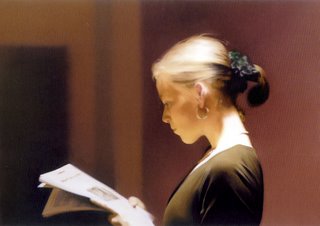
- Gerhard Richter's "Lesende (Reading)" 1994. Richter's slightly blurry photorealist paintings are so beautiful, and this is one of the best. That shockingly attractive woman is his wife, the stud. This painting makes regular appearances on Fosco's laptop as the deskpicture. It is worth visiting Richter's website to see more.
- Fosco was not familiar with the work of Marilyn Minter but he should have been. Minter's art is feminist, sure, but it's also voluptuous and enticing. The SFMOMA is showing "Strut" (2004-05), a painting on enamel of a dirty and sweaty heel in rhinestone-encrusted Dior stilettos. The message is obvious, but it's sooo pretty to look at. See it here. As I was researching Minter, I found another of her works that I adore. It's called "Treasure Trail" (2003) and you can see it below:
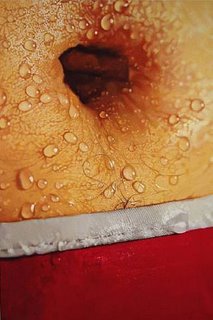 I think this is a remarkably sexy painting, and that response is destabilized (at the same time that it occurs) by questions of the sex of the owner of the navel as well as by questions about objectification and voyeurism. Fosco likes a painting that makes him horny and uncomfortable at the same time.
- Jenny Holzer has been one of Fosco's favorite artists for years. In fact, he even has one of her "truisms" tattooed on his shoulderblade. (Which one? Discover for yourself and receive a complimentary t-shirt.) On display at SFMOMA was Holzer's "I AM A MAN" (1987), a ten foot tall vertical LED board with red and green messages (in all CAPS and with no punctuation) scrolling rapidly upward. Fosco managed to read
- WHY I FIGHT IS NOT YOUR BUSINESS
- THERE IS PLEASURE IN STOPPING MY FLESH WHEN IT DOES WRONG
- I NEED PERFECTION BUT WHEN I IMPLEMENT IT HALF OF EVERYONE DIES
- WHY I FIGHT IS NOT YOUR BUSINESS
- The last highlight I will mention in this exhibit was a painting by Julie Mehretu, Fosco's homegirl from Michigan (reprazent!). Mehretu has (justifiably) become an art star in the last few years (since Fosco saw her coming-out party at the 2004 Whitney Biennial), even receiving a 2005 MacArthur Foundation Grant (Fosco thinks they're nicknamed "genial grants" because the recipients are typically quite friendly). At any rate, Mehretu's compositions are usually quite stunning. They are composed in ink and acrylic paint, but they fool the eye into perceiving several layers of depth, typically including: grids (or askew grids) in ink, lines of movement/force, and brightly-colored almost-recognizable shapes and symbols. The effect is kinetic, but in an energizing (not tiring) way. The SFMOMA recently acquired "Stadia I" (2004), but, unfortunately, I wasn't able to find an image on the web. You can get the idea, at least, from "Stadia III," a painting from the same series:
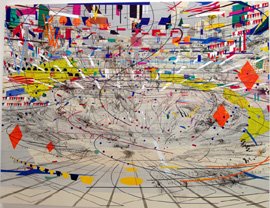 "Stadia I" is a little bit less easily identifiable as a stadium (the flags aren't quite as obvious), but it is essentially similar.


Some representative highlights from several of the other exhibitions (this is turning into a long post and splitting them up doesn't seem worthwhile):
- Charles Sheeler's "Aerial Gyrations" (1953) was really fascinating to me. I wrote a long paper on Sheeler in college and thought I had his "precisionist" style pegged (check out some representative work here), but then this little painting shows up as a nifty surprise. The reproduction here isn't great, so you can't tell that those are pastel colors (not usually associated with Sheeler). And it's so cubist! This isn't the "precisionist" Sheeler. Consequently, this is a really interesting painting and were Fosco an art historian, he would want to spend some time thinking about it. But, as he is only a blogger, he is moving on.

- Creepy architecture from the FUTURE! That's what is designed by Xefirotarch. They do some kind of thing with biological processes that produces shapes that don't exactly occur regularly in geometry. It all looks pretty complicated and math-based to me. Also, as far as I can tell, nothing they have designed has been built. I'm sure that "theoretical architecture" is important and all, but I especially like it when architects build things.
- How can anyone not love Wayne Thiebaud? I love his "Display Cakes" (1963) so much. Thiebaud is brilliant at making food seem otherwordly, comforting yet strange. What planet did these cakes arrive from? And why do they still look so delicious?
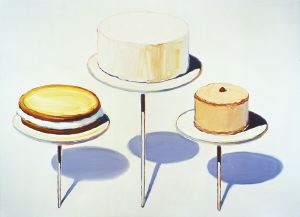 Fosco once spent an incredibly romantic date strolling through the Thiebaud retrospective at the Phillips Collection in DC with a charming young man named Henry. Unfortunately, the object of Fosco's affection later turned out to prefer to date less interesting and less entertaining people... De gustibus non est disputandum. But that date was still bliss, and Fosco has transferred a portion of that affection to Wayne Thiebaud.
- Graphic designer Rex Ray creates posters for concerts and, as a small exhibit in the SFMOMA's Design Collection suggests, they are beautiful. I love this poster for a Radiohead show:
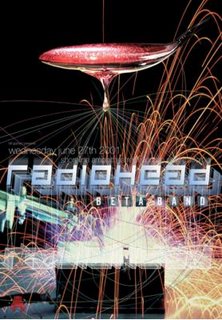

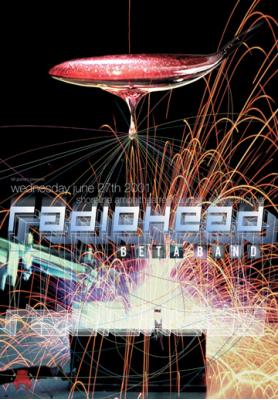
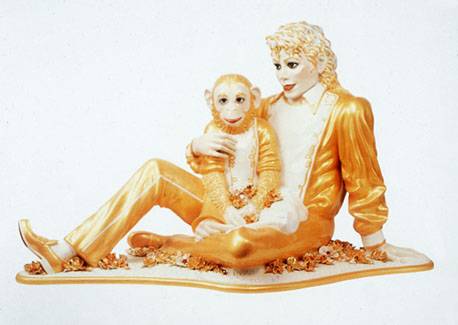
Aren't you impressed that I made it this far and didn't once mention the most famous work in SFMOMA's contemporary collection? Enjoy...
SFMOMA, Part 1: Building Trouble
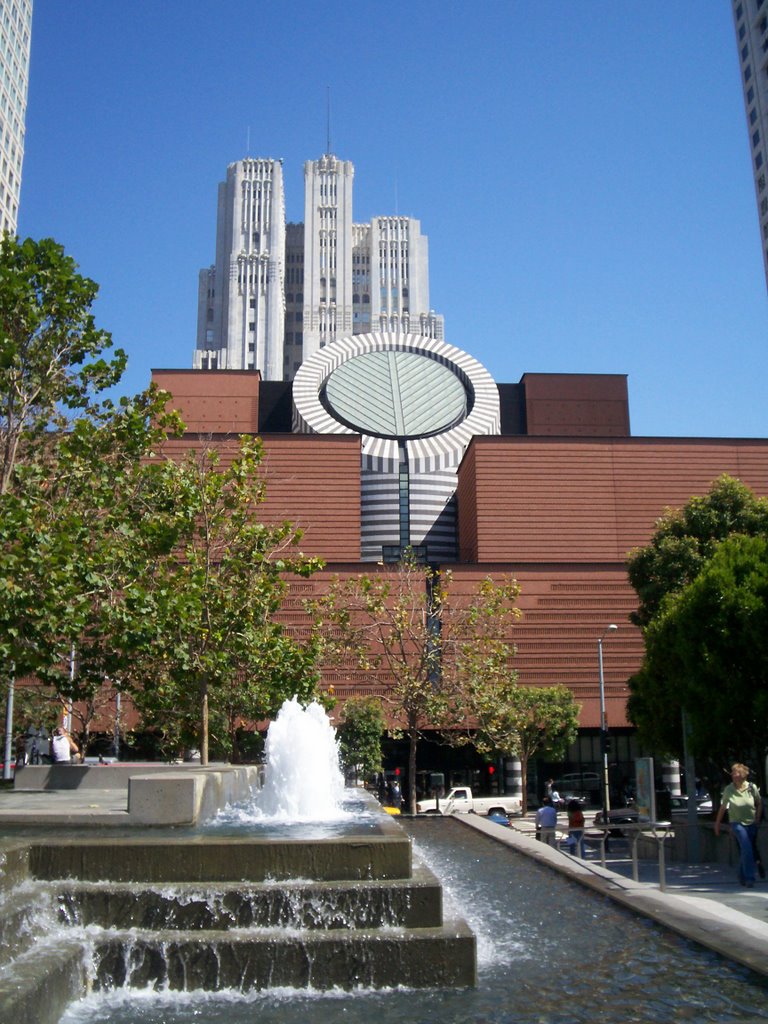 The SFMOMA (picture at right) has resided at its current location south of Market St. for over ten years now. I visited for the first time a year after it opened and, caught up in the local excitement, was impressed by the building, designed by Swiss architect Mario Botta.
Now that the shine has worn off, I have to suggest that the Botta building hasn't really aged that well. Part of the problem, I think is that really tall and shiny buildings have sprung up around it--it makes the SFMOMA look, well, squat. On the inside, the space is still quite lovely and light-filled. However, on the outside, the horizontal stripes don't exactly soar. It's clearly not the architectual icon that San Francisco definitely needs. Of course, I'm not the only person who thinks so.
Speaking of architectural icons in San Francisco, what are the possibilities for the immediate future?
- the new deYoung Museum, designed by Herzog and de Meuron. Despite the exceptional reviews (read Paul Goldberger's New Yorker review--about halfway down in the column), a sustained low-speed driveby by Fosco on Thursday made it look unimpressive. I wanted to like it, but it just didn't do anything for me. I'll give it another chance, sure (and go inside as well), but I'm not optimistic.

- the (recently-deceased?) Prada building designed by Rem Koolhaas. Critics desctibed it as a "giant cheese grater" and it looks like the project is dead. Alas--this is one building I would have liked to see.
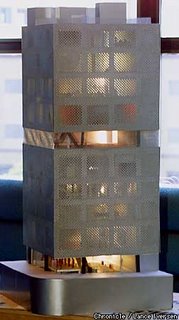
- the Contemporary Jewish Museum, designed by Daniel Libeskind. Visit the website and view the images here.
- I'm really curious to see this one: the "Federal Complex" and Seventh and Mission. The problem, of course, is that no city wants its most iconic building to be a government office building.


Thursday, September 14, 2006
Drawing Restraint 9: Eight things NOT overheard on the way out of the theater...
 It's 9 pm, and Fosco just returned from another day trip to San Francisco to see yet again Matthew Barney's film Drawing Restraint at the SFMOMA. (It turns out that the film is just like Miss E...so addictive!)
Fosco is exhausted (and stuffed with Nanking scallops). He is (finally) ready to write his full review of the film and exhibit--look for it tomorrow. Until then, do two things:
1. Watch the trailer.
2. Enjoy the following bit of silliness.
(N.B., if you don't know much about the film, some of these will be funnier after you read Fosco's full review tomorrow).
- "My favorite part was the dialogue."
- "I wish it had been longer."
- "Now I'm hungry for sushi!"
- "I don't understand what he sees in Bjork..."
- "I hear there were script problems from day one."
- "I still don't understand why Gene Shalit hated it."
- "What do you think Bjork will wear to the Oscars this time?
- "Who did the music?"
FOSCO.

 Posts


