Saturday, September 02, 2006

Denouement: 8/27-9/2

This week, while you were packing your Subaru for Burning Man, Fosco was

Happy Labor Day Weekend!

From the Annals of Excessive Packaging

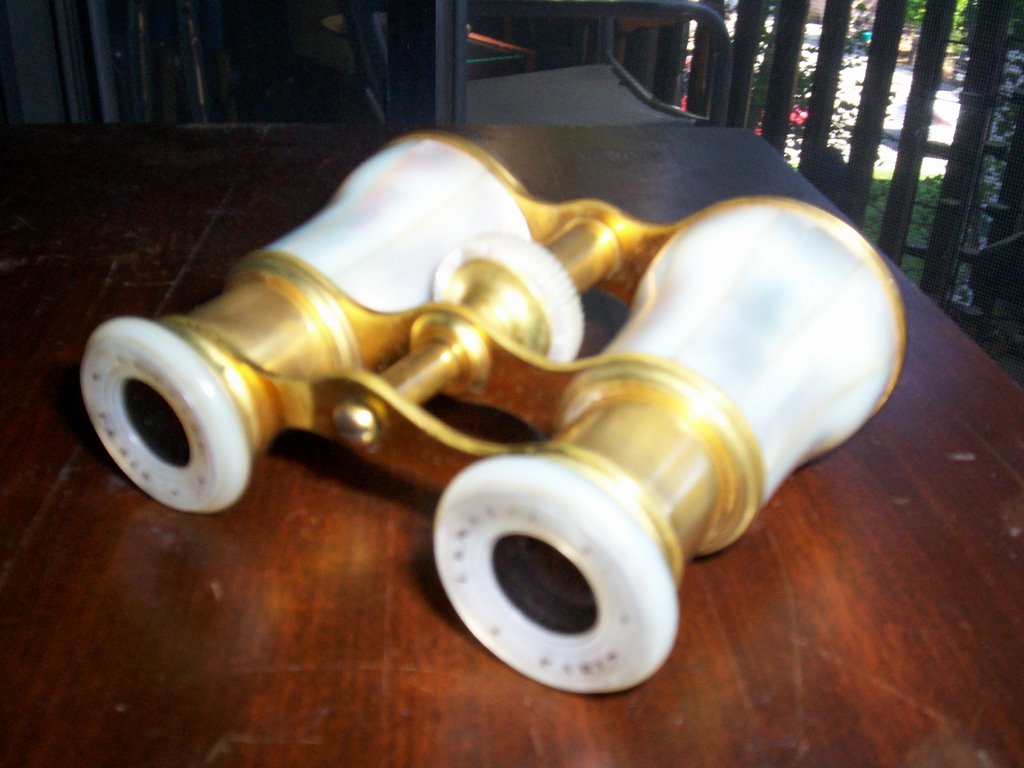
Fosco has a thrilling opera season ahead of him, already having bought tickets to not just one but two (Tan Dun! Placido Domingo! Zhang Yimou! Ha Jin!) operas. Serendipitously, Fosco found a lovely pair of 19C French mother-of-pearl opera glasses on eBay.

The glasses are about 3x5x2, and you can see them in this picture:


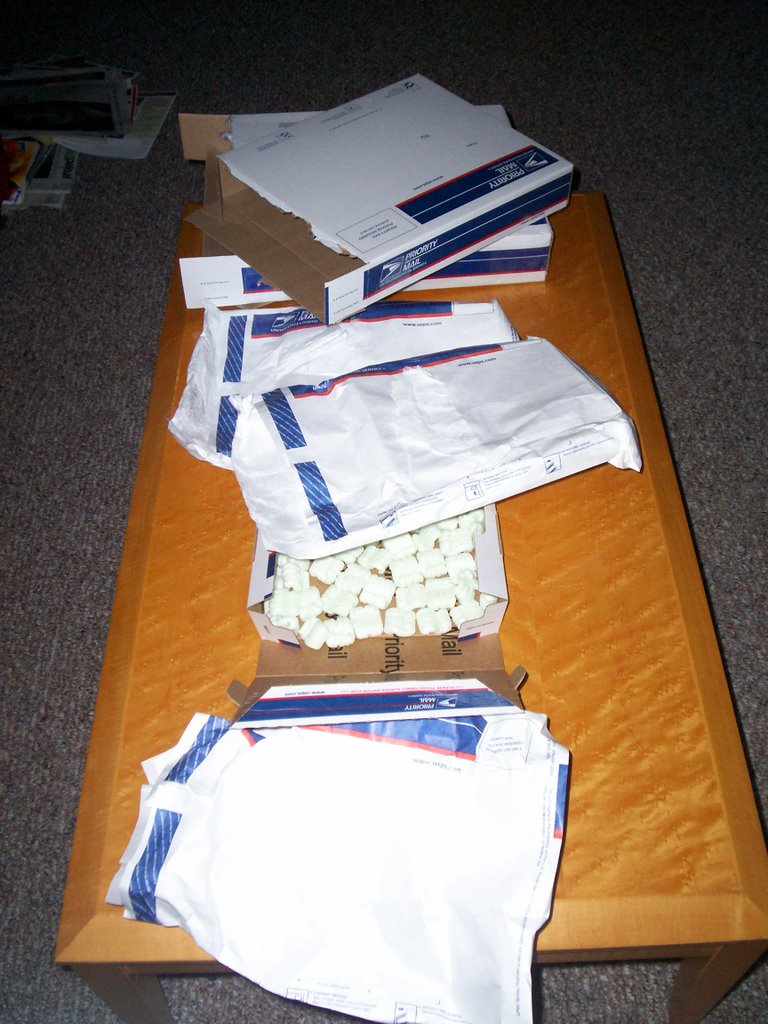
They arrived today, wrapped in

  • a sealed plastic envelope, packed with
  • styrofoam peanuts, inside a
  • small cardboard box, inside a
  • sealed plastic envelope, inside another
  • sealed plastic envelope, inside a
  • larger cardboard box, paked with
  • styrofoam peanuts, inside a
  • larger cardboard box.
You can see the packaging below:

As happy as Fosco is to have received his lovely opera glasses intact, he does wonder if there was a better way

I'm on fire: Fosco at Burning Man

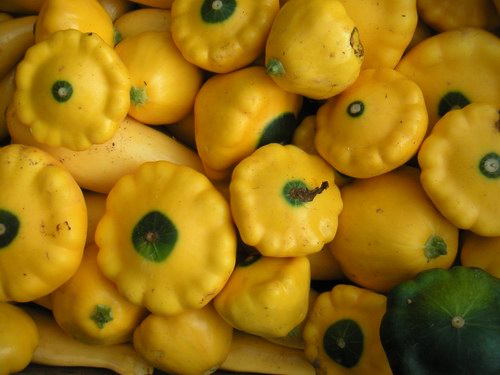
It's going to be a busy day here at Burning Man. As he writes this, Fosco is sitting inside a shade structure shaped like a giant patty pan squash. It is over 100 degrees and Fosco has a blistering case of sunburn. But it's all worth it: the MAN burns tonight!

Read some other blogs about Burning Man--Fosco is pretty sure that he made out with that Seth guy last night.

Oh wait...

Or maybe Fosco is laying on his couch with a tumbler of iced tea, watching College Football Kickoff Weekend.

Friday, September 01, 2006

As we embark on another school year...

In his peripatetic academic career, Fosco has taught at a range of academic institutions--from top liberal arts institutions to local commuter colleges. Consequently, he feels he has a pretty good grasp of the variance between the top and bottom tiers of college students. Even so, he was floored by this New York Times article. One of the most upsetting revelations was this:

California State set an ambitious goal to cut the proportion of unprepared freshmen to 10 percent by 2007, largely by testing them as high school juniors and having them make up for deficiencies in the 12th grade.

Cal State appears nowhere close to its goal. In reading alone, nearly half the high school juniors appear unprepared for college-level work.

Half of high school juniors are unprepared for college-level work? What in the name of Mavis Beacon is going on in high school? Is it now just a big four-year orgy?

Now, Fosco doesn't want to be a bad liberal or an elitist or anything, but is it possible that too many people are going to college? Of course, Fosco is in favor of everyone learning the necessary math and reading skills to negotiate everyday life. But what if that could be done in one or two-year trade schools? If we stopped requiring a bachelor's degree for entry-level employment, maybe our colleges wouldn't be overstuffed with unprepared students.

Thursday, August 31, 2006

We're here, we're queer, and we're looking for Matt LeBlanc

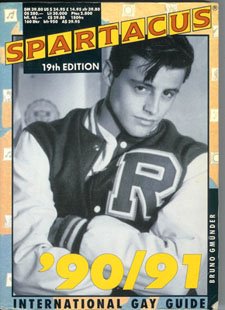
When Fosco was choosing a college in the early 1990s, how was he to know which university would serve as the best incubator of his latent queerness? All he had to rely on were publications like the Spartacus Guide (pictured left), which strictly speaking, aren't even college guides at all (despite the potentially-misleading cover). Fosco feels for you, his deceived queer brethren, who embarked on a four-year course of study at Rim U, hoping to meet the handsome varsity athlete pictured on the cover of the 90/91 Spartacus Guide. Fosco can imagine your sense of betrayal when, a few years later, you finally find the missing cover boy on "Must See TV" and discover that he is probably not (?) gay.

But now, college-bound queers need not suffer for lack of information, thanks to the The Advocate College Guide for LGBT Students.

As Fosco is A) well past college age, B) no longer willing to date high school students (so stop calling, Casey), and C) on a budget, he has no intention of actually purchasing a copy of this guide. However, he is quite curious about its contents, especially concerning his current academic affiliation, his various previous academic pit stops, and his alma mater...

For understandable reasons, the promotional material for the guide is very tight-lipped about the rankings, although they do list the Top 20 (unranked in alphabetical order). Gratifyingly, UCSC is one of three UC schools to make the top 20. There are a few surprises, I would suggest: Duke? Princeton? Clearly the East Coast preppy establishment has changed a bit in the last decade or so (or has it?). I mean sure, Duke used to have an exceptional Queer Theory contingent, but (last time I checked) the school is located somewhere in North Carolina (the exact location is unavailable at press time).

Luckily, local broadsheet Metro Santa Cruz has revealed some of the rankings within the Top 20, and this is where things get interesting. Ranked higher than UC Santa Cruz is... El Ohio State University. WTF?

Now, Fosco is willing to do a little (a very little) research and he has discovered that the campus resources for LGBT students at OSU do appear to be excellent. There is also the fact that OSU boasts the best-funded scholarship program for LGBT students in the nation. Sounds good... maybe even better than UCSC, but what about when you want to leave campus?

When you're a young queer, would you really want to go to a college (even a very gay-friendly college) in a place with

Case closed.

And what of Fosco's Crimsonish alma mater? According to Metro, the Big H
didn't make it into The Advocate's guide at all this time around, partially due to the absence of an anti-discrimination policy that applies to transgender students at the time the book went to press. Harvard has since changed its policy.
Well, that sounds about right.

Tuesday, August 29, 2006

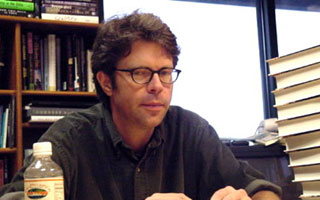
Jonathan Franzen is incredibly... likeable?

Last night, Fosco attended a reading at the delightful independent bookstore Bookshop Santa Cruz. While Fosco is not usually an author groupie, he would have hated to miss an appearance in his town of that most feared literary monster... The Kraken!

Oh wait, not the Kraken. But a creature just as fearful: Jonathan Franzen!

That's right, children: shudder! Your old Uncle Fosco was actually in the same room with the unpredictably cranky bad boy of contemporary fiction. The man who is unafraid to share his unfriendly opinions about the current state of the art. The man who is guilty of the metaphorical equivalent of shooting Oprah in the face. The man whose most recent book has been described by book review empress Michiko Kakutani as "an odious self-portrait of the artist as a young jackass: petulant, pompous, obsessive, selfish and overwhelmingly self-absorbed" (read the whole sharp-clawed review here).

Naturally, Fosco was excited to see what would happen at a Jonathan Franzen reading. Would he become enraged by a photographer's flash and maul the front row? Would he petulantly storm from the podium the first time an elderly woman coughed into her handkerchief? Would he try to one-up Norman Mailer by doing racist impressions of Michiko Kakutani? Ooooh, Fosco was tingling with excitement.


So were nearly 150 other Santa Cruz residents: book-loving lesbians, UCSC types, the lifelong learning elderly, and some homeless people. The room was packed and the crowd was salivating. Would our thirst for spectacle be satisfied?

Ummm. No. Because the old "evil" Jonathan Franzen has been replaced with a new "extremely likeable" model.

It turns out that Franzen is a regular in the area--he spends three and a half months a year in a cabin in nearby Boulder Creek. Because of this, he knows a lot of people in Santa Cruz. Apparently, he was only expecting his acquaintances to attend the reading, because he seemed genuinely surprised that the room was filled with "people I don't know personally" and he thanked us for coming, calling it "heartwarming."

About the new memoir, he was self-deprecating and humble, noting: "I don't know what to make of it and I'm trying not to apologize for it."

His reading was skillful and he came across as entirely genuine.

After he read, he offered to answer audience questions, which he did for an extended period of time (and quite good-naturedly). Some highlights from his answers:

  • He started summering near Santa Cruz several years ago, because he "saw the pelicans and I was sold."
  • He likes Santa Cruz because "something was bottled from the year I was in 8th or 9th grade and released in quantity here."
  • He considered much of the flap about The Corrections to be "humiliating."
  • His favorite local bird is the California towhee.
How can you not like this guy?

After the reading, he gamely signed books (even signing up to ten copies for some totally RUDE geeks). As he signed my book, we talked about the particular virtues of birding in Santa Cruz as opposed to birding in the Midwest. He was friendly, charming, and seemed to be enjoying the evening.


And now, Fosco is confused. If Jonathan Franzen isn't the monster we've been led to believe, what other conventional wisdom might be wrong?
Ahhh! The world crumbles!

Falafel of Santa Cruz: Mondays without Falafel Always Get Me Down

[The most recent of Fosco's weekly restaurant reviews]

Yesterday, I suggested to my personal assistant Geoffrey that we have lunch at Falafel of Santa Cruz, one of my new favorite restaurants in the Cruz. When we pulled up, we realized that we've unintentionally done this exact same thing the last four Mondays (and only on Mondays).

For some reason, Fosco really craves falafel on Mondays--and not just any falafel.

The food at Falafel of Santa Cruz is excellent. It is probably the best falafel that I've ever eaten (although I've never been farther East than Poland). The gyros are exceptional. The dolmas are good. The tahini sauce is meh, but you can add hot sauce. (And actually, the falafel is so good it doesn't really need sauce).

Even better are the french fries--the best in Santa Cruz.

And how can you beat the Falafel Special?

  • Large falafel sandwich
  • Large fries
  • Large soda
All for $6.75.

There's no atmosphere, but who cares? Take your falafel and go somewhere pretty--I hear there's a beach somewhere in town.

Monday, August 28, 2006

Books might be better than people: Some thoughts on Rick Moody

So there's the matter of Rick Moody. Last week, I was browsing at the exceptional Santa Cruz bookstore Logos when I noticed an attractively-designed paperback copy of Moody's first novel, Garden State. Because I have always meant to read Rick Moody and because I liked the cover design and because I can be a sucker for stories of slacker disaffection (especially right before school starts) and because I thought it might be enjoyable to picture Zach Braff as the novel's protagonist just as he was in the movie adaptation (more on this later) I bought the book (for $7.20 plus tax--an odd price now that I think about it). Now, having read only this novel in Moody's oeuvre, I offer some thoughts about Garden State and Rick Moody.

1. He can be a really good writer. There are some excellent sentences in this novel--epigrammatic sentences, like the one that I've quoted as the title of this post. It certainly encapsulates the question I've been weighing for years (but the "might be" leaves plenty of wiggle room).

And how can you not love a sentence like: "Ghosts were the New Jersey state bird."? Change that sentence to present tense and you have as perfect a sentence about New Jersey as has ever been written.

2. Sometimes good ideas get trapped in really bad sentences. For example:

"Human bonds all broke up, fragmented, shattered, exploded, she thought right then, resolution or no resolution, according to whatever explosives were at hand, and that was what she really wanted to tell Lane, but she didn’t see that it had much to do with him, especially since it was she, Alice, who was a breaker of bonds, a violator of families, a dead soul on the eternal Garden State Thruway of dead souls."

Now there are things I like about this sentence: "Garden State Thruway of dead souls" is a pretty good line. And I like the idea that, while the breaking of human bonds is inevitable, the means by which this process occurs are improvised and contingent ("according to whatever explosives were at hand"). This seems true to me.

However, "according to whatever explosives were at hand" is a pretty clunky phrase. Is "according to" really the right prepositional phrase here? Wouldn't "with" work better?

3. This book would have made a terrible movie. I haven't seen the movie, so as I read the novel, I kept asking myself questions like "how could this have been adapted into a coherent movie?" or "how did the director deal with that scene?" Luckily, as I discovered later, the movie Garden State is not based on the novel Garden State (although some inevitable similarities seem to exist).

However, I do think it is a worthwhile exercise for the reader of the novel to picture Natalie Portman and Zach Braff as the main characters in the book. This improves the likeability of said characters by a full standard deviation.

4. According to (note the appropriate use of the prepositional phrase!) the concordance for the novel compiled by Amazon.com, the word "fucking" occurs in the book more frequently than the word "home." That's hot.

5. I've been stalling, but finally I have to say it: sometimes Rick Moody is not a good writer. This is the paragraph that I hated most in the whole novel:

"She decided to take a sleeping pill. Before she had even finished making the decision she was in the bathroom, over the medicine cabinet. Maybe she liked the sleeping pills a little too much. She noticed how the paint was peeling in the bathroom, along the ceiling, as she swallowed. Back in her bedroom, a house fly made impossible right angles unable to find the inch of open window to freedom. Scarlett set the jar of sleeping pills on the floor beside her bed. Angels smiled on the well-rested. God loves sleepers and those who wake."

But then again, I could just as easily have chosen this paragraph:

"The buzzer sounded. Harsh and unexpected. Scarlett moved the bass and stepped over the television cord dangling between the table and the wall. But then she advised herself to stay put. She snatched up the martini, sipped it, replaced it on the table. She decided to establish the identity of the intruder. She stuck her head, again, out the window. Breezes blew."

[I'm going to ignore some obvious questions, like "was it really a 'jar' of sleeping pills?"]

I don't think that I've chosen uncharacteristic paragraphs to criticize: Moody's style is to write paragraphs like these, with a mix of indirect discourse, free indirect discourse, strangely out-of-place references to other styles of writing (such as the police-report tone of "establish the identity of the intruder" or the religious platitudes at the end of the first passage), plus some ambiguous declarative statements ("Breezes blew"--wtf?). However, he usually does it better. The problem is that when you're trying to manage so many types of discourses, it can be too easy to screw up the tone.

6. Novelist and critic Dale Peck hates Rick Moody a lot.

Peck's entertainingly vicious review begins with the infamous line "Rick Moody is the worst writer of his generation"--clearly an exaggeration, as Rick Moody's generation presumably includes Mitch Albom, Neil Gaiman, and (Saints preserve us!) Dan Brown. Hmmm, maybe even Ethan Hawke would qualify... Probably what Peck means is that Rick Moody is the worst good writer of his generation, which is still a pretty powerful statement.

But is Peck right? He does land some punches on Moody, but that's easy enough to do. One of his most accurate criticisms of Moody is that his prose is imprecise. Peck's close reading of the first paragraph of Moody's The Black Veil is like shooting fish in a barrel (although it's pretty funny).

Is linguistic imprecision really a valid criticism of a novel? Do we really want to hold contemporary novelists to that standard? The question that Peck never fully addresses to my satisfaction is the effect of Moody's imprecision: does it prevent meaning or does it actually produce a type of meaning? Or, to put it another way, is Moody linguistically careless or does he know exactly what he is doing? That Garden State managed to produce meaningful and specific emotional responses in this reader seems to suggest that Moody is doing something right, but I will reserve judgment until I read some of his other novels.

You can read the full review here.

Sunday, August 27, 2006

Creepy Tales from Santa Cruz Past

Here are two spoooooooky things about Santa Cruz that I learned on exactly the same day...

1. In August of 1961, a large flock of sooty shearwaters ate tainted plankton, became aggressive and confused, then flew ashore in the dark, smashing into all obstacles in their way.
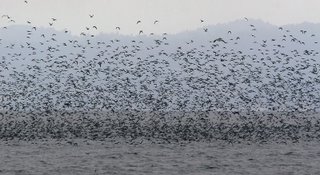

Here are some of the best parts of the story, as reported by the Santa Cruz Sentinel:

"A massive flight of sooty shearwaters, fresh from a feast of anchovies, collided with shoreside structures from Pleasure Point to Rio del Mar during the night.

Residents, especially in the Pleasure Point and Capitola area were awakened about 3 a.m. today by the rain of birds, slamming against their homes.

Dead, and stunned, seabirds littered the streets and roads in the foggy, early dawn. Startled by the invasion, residents rushed out on their lawns with flashlights, then rushed back inside, as the birds flew toward their light.

[...]

When the light of day made the area visible, residents found the streets covered with birds. The birds disgorged bits of fish and fish skeletons over the streets and lawns and housetops, leaving an overpowering fishy stench."


Of course, the best part of the story is this paragraph:

"The word of the bird invasion spread fast throughout the state. Cameramen from San Francisco papers were out in the early morning fog, and a phone call came to the Sentinel from Alfred Hitchcock from Hollywood, requesting that a Sentinel be sent to him. He has a home in the Santa Cruz mountains."


Two years later, Hitchcock made The Birds. It has been noted that the Santa Cruz incident caused Hitchcock to reconsider his earlier rejection of the eponymous Daphne du Maurier short story as a potential source for a movie.

A freaky story and a charming titbit of movie history, read the full Sentinel article here.

2. In the early 1970s, Santa Cruz became known as the "Murder Capital of the World," as three mass-murderers lived in the county. As the Sentinel rerports, one of them killed woman hitch-hikers because women caused him "grief," while the other two killers appear to have been driven by complete psychosis (one of them killed to "prevent earthquakes"--apparently unsuccessfully).
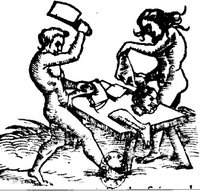
This story is really interesting for several reasons, especially in the ways that the whole thing was interpreted through the disconnect between hippies and the mainstream culture. In the light of 30 years of subsequent history, hippies have come to seem so harmless (although unpleasantly-scented)--for the most part, people no longer associate the extreme left with murder.

Read the full Sentinel piece here.

This is one of the most interesting aspects of Christopher Sorrentino's Trance, a fictionalization of the Patty Hearst kidnapping and a broader portrayal of that era in American history. The stoners and slackers in Sorrentino's novel are totally recognizable to anyone who has spent significant time on a contemporary college campus; however, instead of organizing drum circles, many of the burnouts of the 1960s/70s organized (using that word loosely) violent revolutionary plots. In our culture, the disaffected youths who don't go to college are no longer interested in politics; and the disaffected youths who do go to college, end up learning to express their political disaffection in diversity skits. While this is certainly to be preferred, aren't there some other options? Can't we be leftists without shooting people or performing activist theater?

Instant Karma

Remember yesterday's post, in which Fosco snottily disparaged less-pleasant climates and mentioned his perfect day at the beach? Well, all of the non-residents of Paradise can be pleased that Fosco has received his comeuppance for his weather-related haughtiness.

The picture below is not a photograph of two-thirds of a carton of curiously-hairy Neapolitan ice cream; rather, it is a picture of Fosco's upper thigh taken this morning:


Note the stark demarcation between the skin that was covered by Fosco's shorts yesterday (generally known as the groinal approach) and the skin a bit farther down (known today as ON FIRE!).

OWWWWW!!!

Fosco plans to spend the rest of the day as he did the morning: alternating between whimpering and smearing himself with aloe gel. Cooling aloe gel...

Saturday, August 26, 2006

It's Not Raining Men

When Fosco was a youth and he lived in Rust Belt, MI, what kind of summer weather was worth complaining about? Usually, like 93 degrees with 85% relative humidity.

And when Fosco lived on the East Coast? He remembers some summer days in the Mid-Atlantic in the high-90's that were complete murder.

But, as everyone knows, complaint weather is relative. Now, living in Coastal California, it seems that it is entirely appropriate to complain about a... cloudy day.

In fact, such a cloudy day is worthy of an article in the regional newspaper of record.

Of course, this is not to say that the weather in the Cruz isn't odd... There is this whole marine layer that sits on the coast most mornings before the sun burns it off around noon. And even then, it lurks over the MoBay, waiting to return that evening. Fosco has been told that this marine layer is what keeps the coastal temps low, for which he is thankful.

It turns out, however, that the Santa Cruz area is something of a climatological curiosity. Fosco doesn't quite understand the science of it all, but it somehow involves a pressure inversion that produces a "Santa Cruz Eddy." You can read all about it in this journal article, written by Stanford researchers.

Oh, and incidentally, the forecast was correct: today was a beautifully sunny day and Fosco spent the afternoon on the beach.

And in the interests of full disclosure:

Fosco's friend is meteorologist Norm Sprouse with whom he is very close and whose advice he cherishes.

Friday, August 25, 2006

From the Annals of Why Wikipedia Is Lame

I know Wikipedia is useful and all (I use it more than I'd like to admit). But don't you ever get suspicious about the anonymous webcyclopediasts who are writing the entries? I know that the assumption is that multiple iterations of editing by multiple users will result in a more accurate entry (and here is an assumption begging for a debunking--but not by me, not today). But what about those obscure entries with very limited traffic? What's to prevent some lone nut from writing something very odd and untrustworthy?

Here's an example I just came across--a pretty funny one, actually. This is how the Wikipedia entry for Timothy C. Draper ends (and please don't ask why I was reading this entry...):

As an advocate for entrepreneurs and free markets, Mr. Draper is regularly featured as a keynote speaker in entrepreneurial conferences throughout the world, has been recognized as a leader in his field through numerous awards and honors, and has frequent TV radio, and headline appearances.

Mr. Draper is the course creator and Chairman of BizWorld, a 501c3 organization built around simulated teaching of entrepreneurship and business to children.

Mr. Draper served on the California State Board of Education in 1998-9. He launched a statewide cyber-initiative on school choice for the California General Election in November of 2000.

He has a BS in Electrical Engineering from Stanford University, and an MBA from Harvard Business School.

His sister is Becky Draper with whom he is very close and whose advice he cherishes.

Hmmm. The last sentence just kills me. I'm still giggling about it. I wonder which member of Timothy C. Draper's immediate family wrote this entry? Was it... Becky?

Thursday, August 24, 2006

Stalking Betty White

I awoke this morning with an urgent desire to touch a Golden Girl, so my personal assistant Geoffrey and I took an afternoon drive down the coast to the charming seaside village of Carmel-by-the-Sea, home of notable figures such as Daytime Emmy winner Jennifer Aniston, National Book Award winner Beverly Cleary, and women's boxing promoter Clint Eastwood.

Not to mention: the lovely and talented Betty White. Wait, I meant this Betty White.

"And did we see Betty White?"

Carmel is, at the same time, absolutely adorable and totally insufferable. The downtown is so cute you could eat it up with a spork: quaint houses, beautiful flowers, and hundreds of art/antique galleries. And dogs! Tons of them, eating on the patios at the delightful restaurants. Wow, what a charming town!

But then you notice the double-parked Mercedes, the Tiffany and Sharper Image storefronts, and the women in pantsuits and sunglasses carrying jumbo Coach shopping bags in each hand... And then, if you're a good liberal, you start to feel a little nauseous. In Carmel, obscenely rich people have managed to create the perfect village for themselves. But should I be enjoying it as much as I am? Isn't it all a bit like, well... Nero?

"Enough of your liberal pieties. Did you see Betty White?"

I had promised a cousin-in-law that I would have lunch at the Hog's Breath Inn, formerly owned by film composer Clint Eastwood. In a way, I'm glad we ate there--it's probably important to get it out of the way so that one move on to the better-looking restaurants in town:


"Damn you, what of Betty White?"

The cottages are in town are actually quite lovely:

And, as far as I can tell (after all, I could only peer into the windows so long before the police arrived), almost no dwarves live inside.

So, while Geoffrey and I were a bit put-off by the conspicuous wealth and whiteness of the town, I expect we will return to try some of the other restaurants--especially if I find a steady boyfriend who might enjoy a romantic dinner...

Oh yeah, we didn't see Betty White.

Wednesday, August 23, 2006

Yes, I'm still making this joke.

I bought some more furniture this week. I also read Judith Butler glossing Foucault:

"The soul is precisely what the body lacks; hence, the body presents itself as a signifying lack. That lack which is the body signifies the soul as that which cannot show." (Gender Trouble, Chapter 3)

Now, allow me to introduce you to that LACK which is my coffee table.


What does it signify that cannot show? I don't know, but I hope all of my guests remember to use coasters.

Sexy Summer Reading

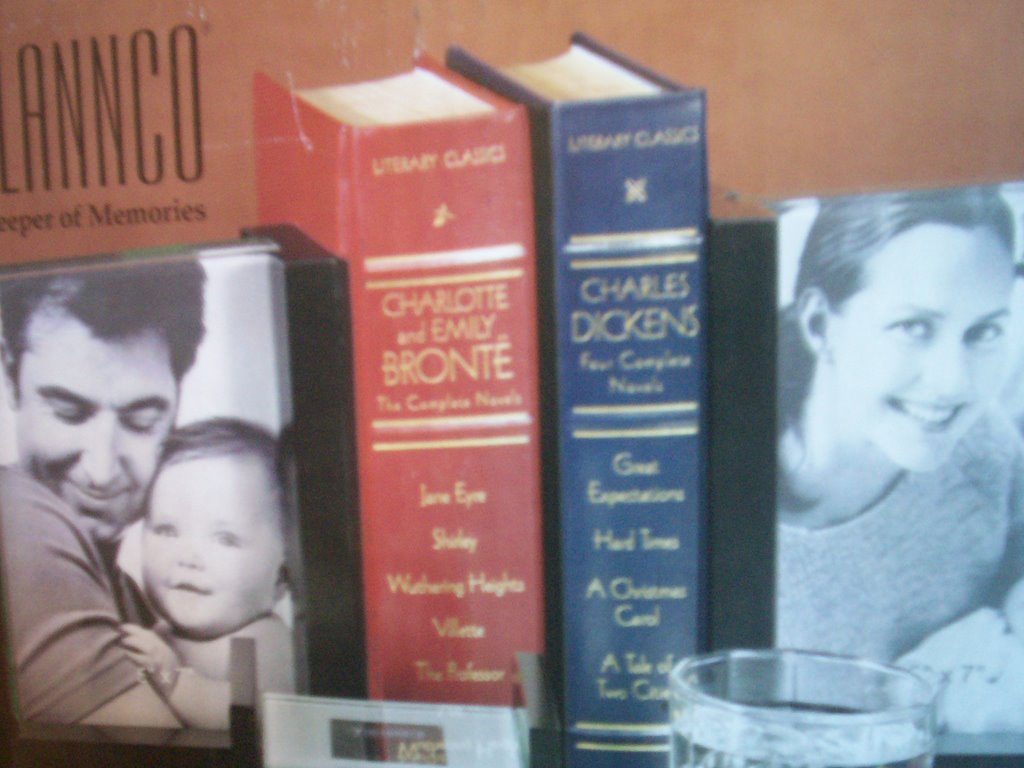
The regular reader may remember Fosco's amusement at new research that suggests Charles Dickens and Emily Bronte are the best beach reading for picking up hotties.

Clearly, Melannco, maker of the picture-frame bookends that you see in the picture below, is familiar with this research.


While he won't question why one needs bookends to keep only two books upright, Fosco does wonder if the lovely (though pale) couple in the pictures actually met on the beach--or is it possible that the aphrodisiac power of these authors works in other public spaces? And what is the name of their sparkly-eyed offspring?

Saturn Cafe: Bohemian Like You

[This is the first of a series of regular restaurant reviews that will usually appear on Sundays.]

But if you dig on vegan food
Well, come over to my work
I'll have 'em cook you something
That you'll really love

'Cause I like you
Yeah I like you
And I'm feeling so bohemian like you


The Dandy Warhols, "Bohemian Like You"

Fosco is not a vegetarian, but he's generally sympathetic to the idea. After all, there is something extremely unappetizing about meat when it's raw. And slaughterhouses sure don't look like fun for anyone (or anything) involved. But then, there is bacon--surely the most glorious food on earth. How could Fosco give it up?

Of course, this doesn't mean that Fosco is unwilling to eat vegetarian food--he loves hummus, vegetarian super burritos, and the incomparable Vegetable Menu at Charlie Trotter's. So, last weekend, he made a visit to the restaurant that the locals describe as "so very Santa Cruz": the Saturn Cafe.

As Fosco sees it, there are two conflicting impulses in vegetarian food: the assimilationist and the separatist. The motivation behind the assimilationist vegetarian chefs is to reproduce all of the glories of meaty cuisine (the cheeseburger, spaghetti and meatballs, buffalo wings) with no meat. This is the impulse that leads to the creation of things like fake bacon, meat-flavored soy patties, and, god help us, Tuno.

The separatist camp of vegetarians is willing to give up traditional meat dishes in favor of foods based on the natural flavors of vegetables and legumes (and their interplay). The separatist vegetarian chef is not interested in finding a vegetarian approximation to the cheeseburger; rather, she wants to create a vegetarian lunch option with its own, distinct flavor. The separatist impulse is responsible for, at the most basic level, foods like the grilled portabello sandwich. At the most advanced level, this impulse will produce something like the "squash and corn ragout with chanterelle mushrooms and fried squash blossoms" at Chez Panisse.

Fosco doesn't want to denigrate too much the assimilationist impulse. After all, strict vegetarians probably do miss cheeseburgers quite a bit. However, as a omnivore who can eat a real cheeseburger when he so chooses, Fosco would rather not bother with a second-rate soyburger. Rather, he is more interested in a vegetarian entree that tastes like the vegetables/legumes/&c from which it is created (and no, salads don't count).

Fosco tends to enjoy most vegetarian restaurants, because most vegetarian restaurants tend to draw from both assimilationist and separatist traditions on their menus. Even in places that serve fake bacon, Fosco can typically find a delicious polenta cake or something. Except, it turns out, at the Saturn Cafe.

The Saturn Cafe is the WalMart for assimilationist vegetarians. Everything they could possibly want is there: burgers, chicken sandwiches, tacos, tuna melts--all made with meat-flavored soy protein (including that satanic Tuno). And, just like WalMart, the interior is a bit cruddy and the employees really don't want to be there.

Unbelievably, there were no separatist vegetarian entrees on the menu! Not even one portabello sandwich or falafel! This is inexplicable to Fosco, just inexplicable.

On his recent visit, Fosco ordered the "grill-flavored" soy patty as a pesto burger. Fosco's personal assistant, Geoffrey, likened the burger's flavor to a "bouillon cube"--the description that an assimilationist vegetarian chef might take as a compliment (although Fosco does not consider this a compliment). The tomato on the burger was underripe and tasteless. The pesto on the burger tasted bottled (a vegetarian restaurant that does not make it's own pesto! Inexplicable!). The fries were fine.

The best praise that Fosco can manage for this place is that they serve the delightfully grapefruity soft drink Squirt--a decision that I'm told is due to a (laudable) desire not to enrich the giant corporations like Coca-Cola and Pepsi. Consequently, Fosco presumes that the owner of Squirt, Cadbury Schweppes PLC, is some sort of Mom-and-Pop operation. (They probably carbonate the soda in their bathtub...)

In conclusion, Fosco can only wonder what makes the Saturn Cafe "so Santa Cruz." Are the residents of his new home really so flaky? Is this what Bohemian life has come to? It is with trepidation that Fosco looks ahead to his second month here.

Tuesday, August 22, 2006

On being an artist in "The Afterthought"

Did you know that [gasp!] sometimes artists can live outside of NYC? But, of course, when you're an artist living in Slackerville USA, you don't want to take art too seriously... Aren't Californians so... exotic?

NYTimes Magazine article on Santa Cruz artist Thomas Campbell

Do you think the local artists in Miami are all salsa dancers?

He ain't heavy, Father, he's my neighbor.


Who doesn't love car-dust graffiti? Living so close to the beach (with the near-constant salty breeze) makes every car that hasn't been washed in the last week a potential tabula rasa for fingertip doodling.

Although Fosco tends to appreciate the classics of car-dust graffiti (and he never disobeys a truck-window command to show his tits), he is not opposed to innovation. Like, for example, the graffito that Fosco encountered in his apartment complex parking lot this afternoon: 100% Boys Town. What could this mean? Is one of Fosco's neighbors a graduate of the famous Omaha-based training academy for male hustlers? Is the owner of the truck, like Fosco, an aficianado of troubled (but legal!) youth? Or is this the tag of an extremely unartistic local gang with an ironic sense of humor?

Ooooh. I hope it's choice number three.

Read Fosco on Father Flanagan's Sodomy Camp.

Bite me.


From the Santa Cruz Sentinel, August 22, 2006:

"Two lifeguards at Manresa responded to a report of a shark thrashing in the water about 75 yards offshore about 12:40 p.m. Saturday, according to Perry. Because there was blood in the area, lifeguards think the shark attacked a sea lion. The Seascape sighting was reported about 2:20 p.m.; lifeguards were unable to say whether it was the same shark."

AWESOME! Fosco is on his way to the beach right now...

Actually, one of Fosco's old pals has been bitten by a shark. Read about it here. It kinda sounds like fun, no?

Sunday, August 20, 2006

Bravo! Bra-a-a-a!

[This review is about a week late, because of... uh, sloth?. Sorry.]

At the more refined passages of the singing, at the more delicate phrases of the music, which passed unapplauded by others, [Fosco's] fat hands adorned with perfectly-fitting black kid gloves, softly patted each other, in token of the cultivated appreciation of a musical man. At such times, his oily murmur of approval, 'Bravo! Bra-a-a-a!' hummed through the silence, like the purring of a great cat.

Wilkie Collins, The Woman in White

While there is little reason to expect an accurate description of Fosco from the narration of a cardboard "hero" such as Walter Hartright, Mr. Hartright does indeed capture Fosco's appreciation for fine music. Fosco has been a devotee of contemporary classical music for some years, even, while living on the East Coast, hosting a weekly classical radio show dedicated to the 20th century on a community station.


Imagine Fosco's surprise and delight to find that, by relocating to Santa Cruz, he had unwittingly moved to the home of the premier festival of contemporary orchestral music in the country--the Cabrillo Festival of Contemporary Music!

Alas, while other commitments (many of them Dickens-related) prevented Fosco from attending most of the concerts and events at this year's festival, he did make it to the "Elevation" concert on Saturday, August 12. Here are his impressions:

The Venue: The composer Mel Powell once said that "Serious new music, like serious old music, isn't made to be dribbled around in a basketball arena." This is probably wrong--at least when it comes to the Santa Cruz Civic Auditorium. While the Civic isn't only a basketball arena (and, for all I know, hasn't been a basketball arena for decades), it does have the shellacked wooden floor of one, in addition to arena-style seating (surrounding the court). This description makes it sound like a terrible venue for orchestral music, but it's actually surprisingly congenial to it. The Festival blocks off one half of the arena (setting up a backdrop behind the orchestra) and covers most of the wooden floor with black tarps. There is no stage--the orchestra is seated on the floor (although there are some risers for the brass and percussion). The effect is extremely intimate and accessible--an effect that is rare in orchestral music. And the sound is really quite good considering the limitations of the space. Would a more traditional concert hall layout be preferable? Well probably, but there is something so appealingly democratic about listening to challenging contemporary music in a glorified gym that I'm just not willing to give up the Civic.

The Orchestra: Again, perhaps my expectations were a bit too low. This was a first-rate orchestra, composed primarily of players from various second-tier orchestras around the country. Maestra Alsop admitted, in a pre-concert address to the audience, that whenever she is asked her favorite orchestra to conduct, she has to resist saying "The Cabrillo Festival" in favor of a more diplomatic evasion. They are totally committed to this repertoire (and spending part of the summer in Santa Cruz is certainly a nice perk). Adding to the intimate atmostphere, the players dress in "business casual." The thing I love best is that all of the players are housed by Santa Cruz residents. Next year, I would love to have the pink-polo-shirt-wearing Assistant Concertmaster stay with me...


The Maestra: Marin Alsop, Intrepid Girl Conductor. How much do I love having a woman conductor (in a field that is still almost totally male-dominated)? And how much do I love that she is TOTALLY AWESOME? She has been the Music Director of the festival for fifteen years and, this fall, takes over as the Music Director of the Baltimore Symphony Orchestra, one of the better second-tier ensembles in the US. (And no, she is not responsible for that orchestra's "Czech It Out!" concert. Thank god.) Of course, she will continue to summer in Santa Cruz.

The best thing about Maestra Alsop? She has the jauntiest lesbian strut ever. It's like the coolest lesbian jazz is playing in her head while she's walking. Absolutely divine.

The Program:

  • Dark Angel (2003), by Daniel Brewbaker. The surprise of the evening--this piece is seductive and well-orchestrated, with both dark and light elements. Powerful, muscular writing for the brass and strings. And I love the subtitle: "Et in Arcadia Ego" [Trans.: "Even in earthly paradise I (death) exist"].
  • Elevation (2006), by Mark Grey. Soloist: Leila Josefowicz, violin. This is Grey's violin concerto, written entirely, according to the composer, on his guitar. Unfortunately, this limitation could be heard--some of the orchestral writing was a bit too thin. There were some very competent passages, but, overall, the work was a bit too similar to John Adams's violin concerto. As a soloist, Leila Josefowicz is charismatic and technically competent (and maybe a bit of a hottie--see above picture). As much as she might like to make this composition a signature piece, I'm afraid that it isn't quite substantial enough.
  • The Whispering Wind (2001), by Michael Gatonska (World Premiere). Primarily a master class for the percussionists. They even got to crumple gold foil!
  • America--A Prophecy (1999), by Thomas Ades. Soloist: Gale Fuller, mezzo-soprano. Clearly, this work was the heavyweight on the night's card. I was excited to hear Fuller, as her voice has been described as sultry and distinctive. Unfortunately, this piece was not the showcase for her voice--there is little room for sex appeal in a libretto that is a Mayan prophecy of the end of civilization. The libretto is powerful, though. I love the first line: "Oh my nation. Prepare." And the final two stanzas are searing:

    Burn, burn, burn
    On earth we shall burn
    We shall turn to ash
    Drift across the land, over the mountains
    out to sea

    Weep, weep, weep
    But know this well:
    Ash feels no pain.


    This was a seriously-skilled orchestral performance of this work, with an unfortunately mis-matched mezzo.


There was even a celebrity sighting: I spotted Pulitzer-Prize-winning composer Aaron Jay Kernis in attendance (wearing a clashing v-neck sweater/collared shirt combination).

And while I may have occasionally yelled "Bravo!" during the applause, let me assure you that I was not wearing black kid gloves. Walter Hartright can bite me.